
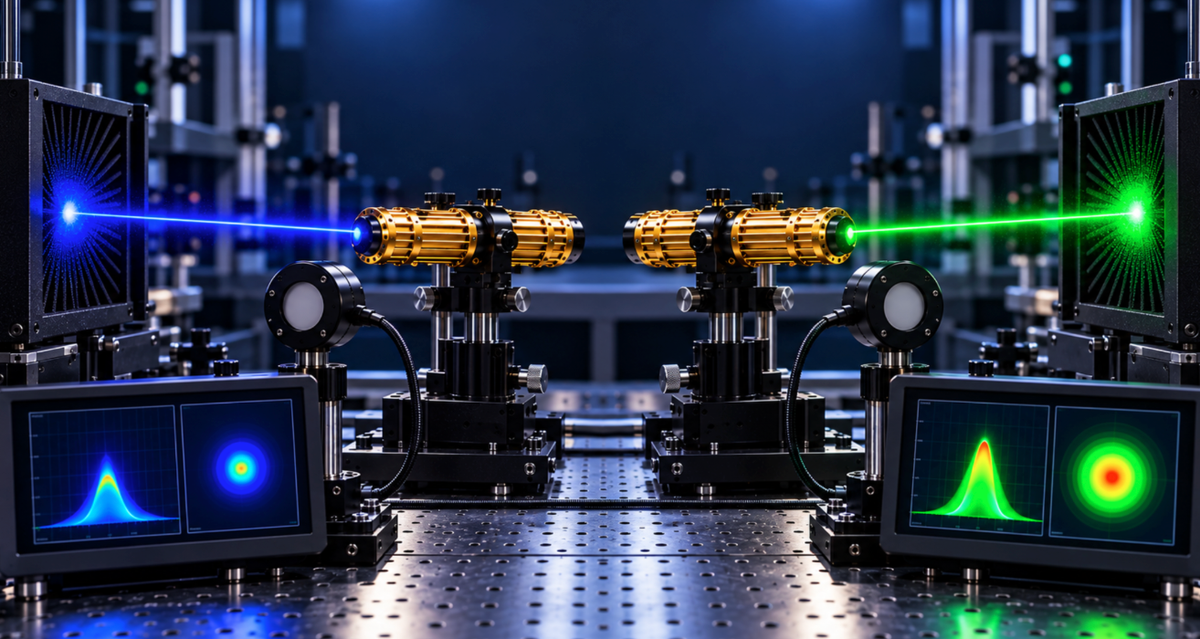
Does a powerful blue laser pointer have more optical power than a powerful green laser pointer, or does green simply look brighter?
These are two different questions. Optical output describes how much laser power a product emits, while perceived visibility depends on wavelength, viewing conditions, and beam characteristics.
At equal measured optical output, green wavelengths such as 520nm and 532nm generally appear brighter than blue wavelengths such as 445nm and 450nm. However, that does not mean blue is always more powerful or green is always the better choice. A meaningful comparison must consider the actual output, wavelength, laser architecture, beam divergence, operating limits, and laser class of the specific products.
Key Takeaways
-
At equal measured optical output, green generally appears brighter than blue because human vision is more sensitive to green wavelengths.
-
Blue and green lasers are both available at different output levels. Color alone does not determine actual mW or W.
-
Common blue products use 445nm or 450nm direct diodes, while green products may use 520nm direct diodes or traditional 532nm DPSS technology.
-
Beam divergence, battery runtime, thermal performance, and operating stability depend on the exact product design rather than color alone.
-
A dimmer-looking blue laser can still have substantial optical output and present serious eye hazards.
-
Compare documented output, laser class, wavelength, operating limits, safety information, and legal requirements before evaluating any higher-output laser product.
Powerful Blue Laser Pointer vs Green Laser Pointer: Technical Performance

Direct-Diode and DPSS Technologies
Many 445nm and 450nm blue lasers use direct-diode technology. Green laser products commonly use two different architectures. A 520nm green laser can use a direct diode, while a traditional 532nm green laser typically uses a diode-pumped solid-state (DPSS) system with infrared pumping and frequency conversion.
These architectures can have different electrical, optical, and thermal characteristics. However, technology alone does not determine which individual product has greater measured optical output, better beam quality, or longer runtime.
High-output blue diode technology is widely available, but this does not make every blue laser more powerful than every green laser.Electrical-to-optical efficiency varies with diode design, wavelength, operating current, temperature, optical losses, and measurement conditions.
Direct-diode technology avoids the frequency-conversion stages used in traditional 532nm DPSS systems, but 520nm green products can also use direct diodes. When comparing actual products, use documented optical output in mW or W rather than broad assumptions about color or efficiency. A higher advertised output should only be treated as a higher claimed rating unless comparable measurement data are available.
Hgyuskl builds around real, measured output rather than printed labels. The company pairs aviation aluminum casings and APC constant current drives with 520nm direct green diode engineering. That direct green approach removes the crystal stage entirely, so the rated figure shows what the aperture actually emits.
Why Green Usually Appears Brighter
Human eyes do not respond equally to every visible wavelength. Under standard light-adapted viewing conditions, visual sensitivity peaks near 555nm. Green wavelengths such as 520nm and 532nm lie closer to this region than blue wavelengths such as 445nm and 450nm.
At equal measured optical output, green therefore generally appears brighter than blue. However, the exact perceived difference depends on the wavelengths compared, visual adaptation, ambient light, beam characteristics, background contrast, and viewing angle. A brightness comparison should not be converted into a fixed beam range, glare distance, or hazard distance without the relevant measurement conditions.
A laser beam becomes visible from the side when some of its light is scattered toward the observer. Clean air produces molecular scattering, while fog, haze, smoke, dust, and other atmospheric particles can change the amount and direction of scattered light.
More scattering may make part of the beam easier to see from the side while also reducing forward transmission. Humidity alone does not guarantee greater beam visibility, and stronger scattering does not mean greater optical output or longer useful range.
At equal measured output, green generally retains a perceived-visibility advantage over common blue wavelengths under typical viewing conditions.
Blue vs Green Laser: Which Fits Your Use Case
Pointing, Presentations, and Everyday Use
A blue-versus-green comparison should start with the exact wavelength and documented optical output. Next, compare laser architecture, beam divergence, operating limits, battery requirements, and laser class.
These factors determine whether two products can be compared fairly. A product's perceived brightness should not be treated as a measure of output, while a larger wattage claim should not automatically be treated as better performance.
|
Comparison Factor |
Blue Laser |
Green Laser |
Buyer Takeaway |
|
Common wavelengths |
445nm / 450nm |
520nm / 532nm |
Compare exact nm values |
|
Perceived brightness at equal output |
Generally lower |
Generally higher |
Green has the visual advantage |
|
Optical output |
Model-specific |
Model-specific |
Color does not prove higher wattage |
|
Direct-diode design |
Common |
Common at 520nm |
Both colors can use direct diodes |
|
Traditional DPSS architecture |
Uncommon at 445/450nm |
Common at 532nm |
Architecture affects operating characteristics |
|
Beam divergence |
Model-specific |
Model-specific |
Compare optical specifications |
|
Battery runtime |
Model-specific |
Model-specific |
Do not rank by color |
|
Thermal performance |
Model-specific |
Model-specific |
Check operating limits |
|
Laser class |
Depends on emissions |
Depends on emissions |
Hazard is not determined by color |
|
Cost |
Depends on product |
Depends on product |
Compare equivalent specifications |
The most meaningful comparison is between products with clearly documented and comparable specifications.
At equal optical output, green generally looks brighter. At different output levels, the result also depends on the size of the power difference. Battery life, divergence, reliability, and operating limits should always be evaluated for the individual product.
Battery Life Cannot Be Predicted From Color Alone
Blue and green laser products can use different diode architectures, output levels, drivers, and battery systems. Traditional 532nm DPSS designs include additional optical-conversion stages, while 520nm green and 445nm or 450nm blue lasers commonly use direct diodes.
However, battery runtime depends on the actual optical output, electrical efficiency, battery capacity, driver design, temperature, and operating duty cycle. A blue laser is not automatically more efficient or longer-lasting than a green laser. Compare the documented runtime and battery requirements for the exact models rather than making a decision from color alone.
High Power Laser Safety and Eye Safety
Laser Class, Optical Output, and Eye Hazard
“High power laser pointer” is an informal search and marketing phrase, not an official laser safety class. Laser class describes hazard potential and depends on the emitted radiation and applicable classification conditions.
In the United States, visible laser products promoted for pointing or demonstration purposes are limited by FDA regulation to Class IIIa / IEC Class 3R, up to 5mW. This is an important regulatory threshold, not a universal definition of “high power” or a guarantee of safe eye exposure. Higher-class laser products require substantially greater attention to classification, beam control, operating conditions, and safety documentation.
|
Laser Class |
Simplified Visible-CW Context |
Main Hazard Meaning |
|
Class 2 / FDA II |
Generally up to about 1mW |
Lower-output visible class; avoid deliberate or prolonged direct viewing |
|
Class 3R / FDA IIIa |
Up to about 5mW in the U.S. pointer context |
Direct viewing can be hazardous |
|
Class 3B / FDA IIIb |
Generally above 5mW and up to 500mW |
Serious direct-eye hazard; requires greater controls |
|
Class 4 / FDA IV |
Above Class 3B accessible-emission limits |
Serious eye and skin hazards; hazardous reflected exposure and fire risks may occur |
These ranges are simplified for visible continuous-wave laser products. Exact classifications depend on wavelength, pulse characteristics, accessible emission, and the applicable standard.
Laser class is a hazard classification, not a rating of product quality, brightness, or value.
U.S. and International Legal Context
Laser regulations vary by jurisdiction, and manufacture, import, sale, possession, marketing, and use are separate legal questions. In the United States, visible products promoted for pointing or demonstration purposes are limited to FDA Class IIIa / IEC Class 3R, up to 5mW.
Higher-class products should not simply be marketed or treated as ordinary pointers. Never direct a laser toward aircraft. In the United States, intentionally aiming a laser at an aircraft is a federal crime. For country-specific restrictions, consult the current local rules and a dedicated laser legality guide.
A dim-looking laser is not necessarily safer. The FDA warns that powerful blue or violet laser beams may appear much less bright than equally powerful green beams. Apparent brightness should therefore never be used as a safety measurement.
Independent NIST testing also found excessive emissions in some commercial laser pointers, including green products that exceeded applicable accessible-emission limits at one or more wavelengths. These findings support checking optical output, laser class, warning labels, manufacturer information, and documentation rather than judging hazard from color or visual appearance.
Cost and Value Comparison
Cost and Value: Compare Products, Not Colors
There is no universal rule that every green laser costs more than every blue laser. Price depends on wavelength, optical output, diode technology, optics, housing design, safety controls, battery system, warranty, and manufacturer. A useful price comparison should use products with documented specifications and clearly identified variants. Do not assume that blue automatically offers more optical power per dollar or that green always costs more because it appears brighter.
Laser class is a hazard classification, not a standard retail price category. Under simplified visible continuous-wave conditions, Class 2 generally covers lower-output lasers up to about 1mW, while Class 3R may extend to about 5mW.
Products with substantially higher accessible emissions belong to higher hazard categories such as Class 3B or Class 4. Retail prices vary by product design, manufacturer, output rating, wavelength, safety controls, and technical documentation.
A low price is not independent proof of inaccurate output, and a high price is not proof of accurate specifications.
What Makes a Laser Product Good Value?
Value should be assessed from documented specifications, operating limits, safety information, and support rather than price alone. Features such as a machined housing, adjustable focus, rechargeable battery system, or regulated driver may contribute to usability.
However, none of these features independently proves measured output, beam quality, longer life, or superior thermal performance. When comparing products at different prices, check the optical output, wavelength, laser class, beam characteristics, duty cycle, battery system, warranty, and documentation.
When evaluating Hgyuskl products, apply the same evidence standards to blue and green models. Regulated driver circuits and metal housings may affect electrical and thermal performance, but their presence does not guarantee a particular optical output, runtime, or product lifetime.
Battery life depends on the exact model's electrical requirements, driver efficiency, diode efficiency, cell capacity, temperature, and duty cycle. Compare model-specific documentation rather than assuming that one construction feature proves overall quality.
A good buying comparison should not begin with the assumption that green is for visibility and blue is for power. Start with the legitimate technical requirement and the exact product specifications.
At equal optical output, green generally appears brighter, but neither color guarantees greater power, lower divergence, longer runtime, or better reliability. Evaluate output, wavelength, beam characteristics, thermal limits, battery requirements, laser class, and documentation together.
Final Answer: Power or Visibility?
At equal measured optical output, green wavelengths such as 520nm and 532nm generally appear brighter than blue wavelengths such as 445nm and 450nm. However, that does not make green more powerful. Optical output must be evaluated separately using documented mW or W specifications.
Blue and green lasers are both available with different output ratings, diode architectures, beam characteristics, operating limits, and safety classifications. A higher-output blue laser can look less bright than a lower-output green laser, but visual appearance should never be treated as a measurement of power or hazard.
When comparing products, check the actual output, wavelength, laser class, divergence, duty cycle, battery system, safety information, and documentation. In short, green generally has a perceived-visibility advantage at equal output, while actual power is determined by the individual product—not by its color.
FAQ
Which Looks Brighter at Equal Power: Blue or Green?
At equal measured optical output, green generally appears brighter than blue under typical viewing conditions. Human visual sensitivity under photopic conditions peaks near 555nm, so 520nm and 532nm green light lies closer to the high-sensitivity region than 445nm or 450nm blue light. The exact perceived difference depends on viewing conditions, beam characteristics, background contrast, and the specific wavelengths compared.
Does a Blue Laser Always Have More Optical Power Than a Green Laser?
No. Both colors are available in different output ranges, and optical output depends on the exact product. Many blue lasers use direct diodes, but 520nm green lasers can also use direct-diode technology. Compare documented mW or W values and measurement conditions instead of assuming that blue is automatically more powerful.
Can a Dimmer-Looking Blue Laser Be More Hazardous Than a Green Laser?
Yes. A blue laser can appear dimmer than a green laser while having substantially higher optical output. Eye hazard depends on output, wavelength, laser class, beam characteristics, and exposure conditions. Class 3B and Class 4 products can present serious eye hazards, and protective measures should be based on the specific product and operating environment. Do not use apparent brightness or the blink response as a safety test.
How Should Buyers Evaluate Blue and Green Laser Power Claims?
Check the stated optical output, wavelength, laser class, warning labels, manufacturer information, and measurement conditions. A wattage number should be understood as a manufacturer's claim unless supporting measurement data are available. Driver type, housing material, or diode architecture does not independently verify actual optical output. Apply the same documentation standards to blue and green products.
Can a Laser Beam Be Visible in Clear Air?
Yes. Molecular scattering occurs even in clean air, so a laser beam can become visible from the side under suitable viewing conditions. Fog, haze, dust, smoke, and other particles can change the amount of scattered light, but greater scattering can also reduce forward transmission. Visibility depends on optical output, wavelength, atmospheric conditions, background light, and viewing angle. Green generally appears brighter at equal measured output, but no color is guaranteed to have the most visible beam under every condition.
Share:
Which Laser Pointer Color Looks the Strongest: Green, Blue, or Red?
Does More Power Make a Laser Pointer Go Farther: Understanding Laser Pointer Power vs Distance