
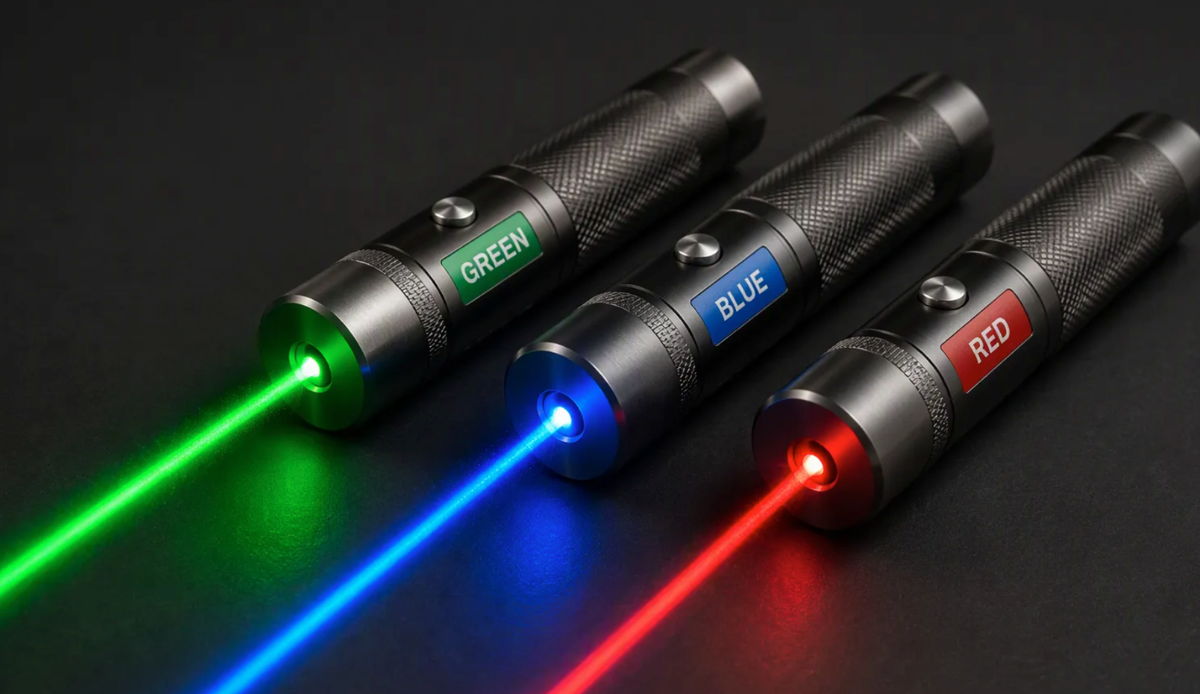
Which laser pointer color looks the strongest: green, blue, or red? At the same measured optical output, green wavelengths such as 520nm and 532nm generally appear brightest to human eyes. However, “looking strongest” is not the same as having the highest optical power.
The comparison between blue and red is more complicated. Under standard light-adapted viewing conditions, a 650nm red laser has higher photopic luminous efficiency than a 450nm blue laser. Under dark-adapted conditions, the eye's sensitivity shifts toward shorter wavelengths, changing the comparison.
This guide explains how wavelength, optical output, viewing conditions, and beam characteristics affect apparent brightness—and why color alone cannot tell you how powerful or hazardous a laser is.
Key Takeaways
-
Green laser pointers generally appear brightest at equal optical output under typical light-adapted viewing conditions.
-
The standard photopic visual-sensitivity curve peaks near 555nm, while dark-adapted scotopic sensitivity peaks near 507nm.
-
At equal optical output, common 450nm blue and 650nm red lasers do not have a universal brightness order across all lighting conditions.
-
A visible dot on a surface and a beam viewed from the side are different visibility questions.
-
Optical output, beam divergence, ambient light, target contrast, and atmospheric scattering all affect what you see.
-
Perceived brightness does not reliably indicate optical power or eye hazard. Check wavelength, mW/W, laser class, and documentation separately.
The Strongest Laser Color and Eye Sensitivity

Why Green Usually Looks the Strongest
Green laser pointers usually have a perceived-brightness advantage over common blue and red pointers when optical output and viewing conditions are comparable. Human eyes are particularly sensitive to wavelengths in the green-to-yellow-green region under light-adapted conditions.
This is why a 520nm or 532nm green laser can look more noticeable than a blue or deep-red laser with the same measured mW output. The difference is caused by human visual sensitivity, not by the green laser automatically emitting more optical power.
How the Eye Responds to Wavelengths
Human vision changes with both wavelength and ambient light. Under light-adapted, or photopic, conditions, visual sensitivity peaks near 555nm in the yellow-green region.
Under dark-adapted, or scotopic, conditions, sensitivity shifts toward shorter wavelengths and peaks near 507nm. This helps explain why a laser color can appear relatively brighter or dimmer as viewing conditions change, even when the laser's optical output remains the same.
Some wavelength comparisons use the CIE photopic luminous-efficiency function to calculate relative photometric output at the same optical power. For example, 532nm green has substantially higher photopic luminous efficiency than either 650nm red or 445nm blue.
However, a photometric ratio is not a universal prediction of subjective brightness or visible beam distance. The exact red wavelength matters too. A 635nm red laser and a 650nm red laser do not have identical photopic luminous efficiency.
Visual adaptation, target surface, background contrast, beam characteristics, and atmospheric conditions can also affect the observed result. For a general comparison guide, it is more accurate to explain these conditions than to promise one fixed brightness multiplier.
Photopic vs. Scotopic Vision
Scientists use different spectral-sensitivity functions to describe how human vision responds under different lighting conditions. Photopic vision applies to light-adapted viewing and peaks near 555nm. Scotopic vision applies to dark-adapted viewing and peaks near 507nm.
Between these conditions, mesopic vision involves a changing combination of visual responses. This means that “the brightest laser color” should always be understood in relation to the viewing conditions and the specific wavelengths being compared.
Green vs Blue vs Red: Wavelength Comparison
Green vs. Blue vs. Red: Comparing Common Wavelengths
Common laser pointer wavelengths include 520nm and 532nm green, 445nm and 450nm blue, and 635nm and 650nm red. These wavelength differences affect human visual response, but the result depends on the viewing conditions.
Under standard photopic conditions, green wavelengths near the sensitivity peak generally produce greater photometric output at equal optical power than common red or blue wavelengths. Under darker conditions, the sensitivity function changes, so the relative comparison between blue and red should not be treated as fixed.
Which Color Looks Brightest at Equal Optical Power?
At equal measured optical output, green generally has the highest photopic luminous efficiency among common 520nm, 532nm, 445nm, 450nm, 635nm, and 650nm laser wavelengths.
However, the order between blue and red is not universal. For example, under standard photopic conditions, 650nm red has higher luminous efficiency than 450nm blue. Under dark-adapted conditions, sensitivity shifts toward shorter wavelengths and the comparison changes. The table below uses specific wavelengths rather than treating every shade of blue or red as equivalent.
|
Laser Color |
Common Wavelengths |
Equal-Power Photopic Comparison |
Dark-Adapted Consideration |
|
Green |
520nm / 532nm |
Generally highest among these common wavelengths |
Remains highly visible; exact result depends on adaptation |
|
Red |
635nm / 650nm |
Lower than green; 650nm can be more photopically efficient than 450nm blue |
Relative sensitivity falls markedly under full dark adaptation |
|
Blue |
445nm / 450nm |
Lower than green and, for the example wavelengths, lower than 650nm red |
Becomes relatively more sensitive compared with deep red |
This table summarizes human spectral sensitivity, not a fixed subjective-brightness score. It assumes equal measured optical output and does not guarantee identical beam visibility, spot contrast, or performance in real-world atmospheric conditions. The exact wavelengths, background, visual adaptation, and beam characteristics all matter.
The comparison is easier to understand when optical power and perceived brightness are kept separate. Two lasers can have the same measured output in mW while appearing noticeably different in brightness because of their wavelengths.
Likewise, a higher-output blue or red laser can appear brighter than a much lower-output green laser under some viewing conditions. The important distinction is that color affects human visual response, while mW or W measures emitted optical power.
Beam Visibility for Green Laser Pointers
Spot Visibility vs. Beam Visibility
A laser's dot on a surface and its beam viewed from the side are different visibility questions. Spot visibility depends on optical output, wavelength, target reflectivity, background contrast, spot size, and viewing conditions.
Beam visibility from the side depends on light being scattered toward the observer. Even clean air produces molecular scattering. Fog, haze, smoke, dust, rain, and other particles can change how much scattered light reaches the eye. More scattering can make part of the beam easier to see while also reducing forward transmission.
Therefore, a beam that looks more visible in fog is not necessarily more powerful, and no wavelength guarantees the same visibility under every atmospheric condition.
Why Beam Divergence Matters
Beam divergence describes how quickly a beam expands with distance. A lower-divergence beam can keep its light concentrated in a smaller spot under comparable conditions, which may improve spot visibility on a target. However, divergence does not increase the laser's total optical output.
Beam diameter, beam profile, focus setting, and optical design also affect how the spot appears. This is why two lasers with the same wavelength and mW rating can produce different-looking spots at distance.
Power, Safety, and Your Laser Pointer
Why the Brightest-Looking Laser Is Not Necessarily the Most Powerful
Perceived brightness is not a reliable measure of optical output or eye hazard. A laser that looks relatively dim may still emit substantial optical power.
Laser classification depends on accessible emission and the applicable standard, including factors such as wavelength, emission duration, pulse characteristics, and exposure conditions.
Manufacturers should provide the appropriate laser class, output specification, warning labels, and product documentation. For readers, the practical lesson is simple: use wavelength to understand color and visual sensitivity, but use documented optical output and laser class to evaluate the product's emitted power and hazard.
When comparing Hgyuskl products or competing laser models, check the same information for every listing. Useful specifications include the stated optical output, wavelength, laser class, warning labels, manufacturer information, and measurement conditions where available.
A product's printed wattage should not be described as independently verified unless supporting measurement evidence is available. Clear specifications support informed decisions, but they do not eliminate the hazards associated with higher-class lasers.
Laser Classes and Responsible Use
|
Laser Class |
Simplified Visible-Laser Context |
What Readers Should Know |
|
Class 1 |
Considered non-hazardous under normal operating conditions |
Do not generalize to exposed internal radiation or altered products |
|
Class 2 |
Lower-output visible class, generally up to about 1mW |
Avoid deliberate or prolonged direct viewing |
|
Class 3R / FDA IIIa |
Up to about 5mW in the U.S. visible pointer context |
Direct viewing can be hazardous |
|
Class 3B / FDA IIIb |
Generally above 5mW and up to 500mW for visible CW products |
Serious direct-eye hazard |
|
Class 4 |
Above Class 3B accessible-emission limits |
Serious eye and skin hazards; reflected exposure and fire hazards may occur |
Laser class describes hazard potential, not perceived brightness or product quality. The following table provides a simplified overview for commonly encountered visible laser products.
Exact class limits depend on wavelength, emission characteristics, and the applicable classification standard. A higher class should never be interpreted as a better or more desirable laser pointer.
Matching Color to Your Use Case
Green wins as the strongest laser color because your eyes peak near 532 nm. Perceived brightness is not power. A modest red laser pointer can outpower a vivid green laser pointer.
Blue and red laser pointers each bring strengths. Blue suits dark scenes; red reads well in bright rooms. The strongest laser color for you depends on the task.
Choose laser pointers by use case, honest milliwatt ratings, and safety. Verify real-output specs on any laser pointer, and keep your eyes safe with every beam. Safety and truth beat raw brightness. Compare laser pointers on real specs. Serious laser pointers reward that habit, so step up to laser pointers built to true output.
Conclusion: Which Laser Pointer Color Looks Strongest?
At equal measured optical output, common green wavelengths such as 520nm and 532nm generally look brightest to human eyes under typical light-adapted viewing conditions. However, the apparent brightness order between blue and red depends on their exact wavelengths and the observer's visual adaptation.
A brighter-looking laser is not necessarily more powerful, and a dimmer-looking laser is not necessarily safer. To compare products accurately, distinguish optical output from perceived brightness, spot visibility, beam visibility, and laser class. The simplest answer is that green generally looks strongest at equal output, but actual power and hazard cannot be judged from color alone.
FAQ
Does a Green Laser Pointer Always Look Brighter Than a Blue One?
Not always. At equal measured optical output, common green wavelengths generally appear brighter than 445nm or 450nm blue under typical viewing conditions. However, a higher-output blue laser can appear brighter than a much lower-output green laser. Visual adaptation, background contrast, beam characteristics, and atmospheric conditions also affect the result.
Why Do Green-vs-Red Brightness Estimates Vary?
Brightness comparisons often use different red wavelengths and different viewing conditions. For example, 635nm and 650nm are both red, but they have different photopic luminous efficiencies. Some numerical ratios describe standardized photometric output at equal optical power rather than universal subjective brightness. Ambient light, visual adaptation, target contrast, and beam characteristics also influence what people actually see.
Can a Red Laser Look as Bright as a Green Laser?
Yes, under some conditions. A red laser with higher optical output may appear as bright as or brighter than a lower-output green laser. At equal measured output under typical photopic conditions, however, common green wavelengths generally have much higher luminous efficiency than 635nm or 650nm red. The comparison depends on wavelength, output, viewing conditions, and beam characteristics.
Is Blue Brighter Than Red at the Same mW?
Not under every viewing condition. For example, under standard photopic conditions, a 650nm red laser has higher luminous efficiency than a 450nm blue laser at equal measured optical output. As the eye becomes dark-adapted, visual sensitivity shifts toward shorter wavelengths, which changes the relative appearance of blue and deep red. The exact wavelengths and viewing conditions matter more than the broad color names.
Share:
Most Powerful Green Laser Pointer: What Should You Compare Before Buying?
Powerful Blue Laser Pointer vs Powerful Green Laser Pointer: Power or Visibility