
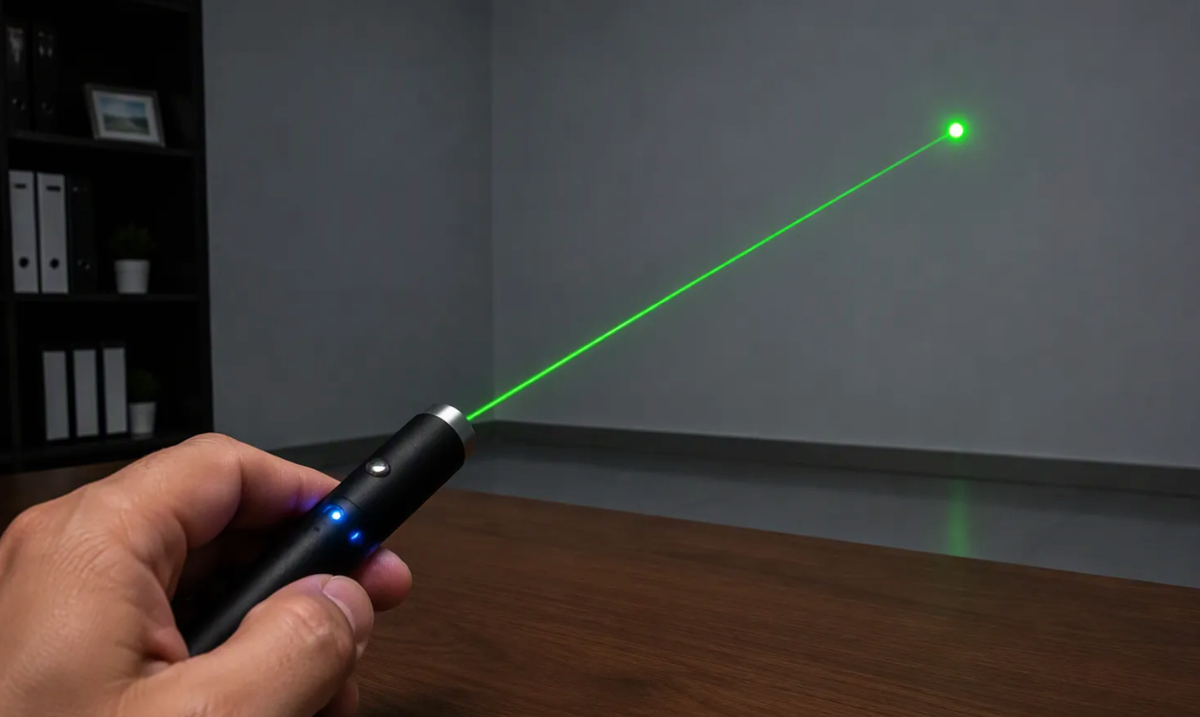
Does more power make a laser pointer go farther?Not in the sense of automatically producing a narrower beam or changing how laser light propagates. However, higher optical output can make a distant laser spot easier to detect when the wavelength, beam characteristics, target, and viewing conditions are otherwise comparable.
The key is to distinguish three different ideas: how laser light propagates, how far a spot or beam remains visible, and how far the laser may present a hazard.Beam divergence affects how quickly light spreads. Optical output affects how much power is available. Atmospheric conditions, wavelength, background light, target reflectivity, and viewing angle affect what an observer can actually see. This guide explains laser pointer power vs. distance without treating wattage as a simple range rating.
Key Takeaways
-
Higher optical output can improve distant-spot detectability under comparable conditions, but it does not automatically reduce beam divergence.
-
A laser beam does not stop at a fixed distance simply because its power rating is low.
-
Beam divergence determines how the beam expands, while target irradiance also depends on optical power, beam profile, and atmospheric transmission.
-
A visible spot on a target and a beam viewed from the side are different visibility measurements.
-
Eye-hazard distance and visual-detection distance are different quantities and should not be calculated from wattage alone.
-
Laser classification and legal requirements depend on product type, wavelength, emission characteristics, jurisdiction, and intended use.
Laser Pointer Power vs Distance: The Short Answer

Laser light does not have a fixed maximum travel distance determined by its mW or W rating. As the beam propagates, diffraction and optical design affect its size, while atmospheric absorption and scattering can reduce the power transmitted along the path.
As the beam expands, its optical power is distributed over a larger area. This can reduce irradiance at a distant target. Increasing output power can increase irradiance under comparable conditions, but it does not automatically improve beam divergence or optical quality. Practical visibility depends on the beam, the target, the viewing conditions, and what level of light the observer or detector can recognize.
Why Power Alone Does Not Control Beam Spread
Laser beams generally expand as they propagate because of diffraction and the characteristics of their optical systems. Beam divergence describes the rate of this expansion and is commonly expressed in milliradians (mrad).
Two lasers with the same output power can have different divergence, initial beam diameters, and beam profiles. Similarly, two lasers with comparable optics but different output powers may have similar beam expansion while producing different irradiance at the same target distance.
Power and divergence should therefore be treated as separate specifications. Here is the practical result. The spot grows, and the same energy now covers more area. Light intensity at the final lit spot falls. A 1 kW fiber laser shows this clearly:
Why a Larger Spot Can Look Dimmer
When a laser beam expands, the optical power is distributed across a larger area. For the same power reaching the target, a larger illuminated spot generally has lower average irradiance.
Increasing the emitted power can offset some of this reduction under comparable conditions, but it does not correct the beam's divergence or make the optical system more efficient. For a general laser pointer guide, this relationship is more useful than a fixed industrial-laser power-density example.
Beam Divergence and Why It Matters
Beam divergence describes how rapidly a laser beam expands in the far field. It is commonly expressed in milliradians (mrad), but specifications may use a half-angle or full-angle definition.
This distinction matters because two products can report different-looking divergence figures simply because the measurement conventions differ. Lower divergence generally means slower beam expansion under comparable optical conditions. However, it does not create a fixed maximum travel distance and should not be interpreted as a complete measure of beam quality.
Rayleigh Range and Beam Quality
In Gaussian-beam optics, the Rayleigh range is the distance from the beam waist at which the beam radius increases by a factor of approximately 1.414 and the beam's cross-sectional area doubles.
This concept is useful in optical engineering, but it is not a simple consumer range rating. Actual beam divergence depends on the emitter, optical design, beam quality, and focusing or collimating system. Neither a DPSS laser nor a direct-diode laser is automatically better collimated solely because of its architecture.
Aperture size shapes the starting beam, and it pairs with divergence to set practical reach. A smaller source spreads faster. So the honest limit on any laser pointer's beam is optical, not electrical. Check the divergence figure before you check the wattage.
Beam Divergence and Aperture Explained
Beam Diameter, Optics, and Divergence
The physical exit aperture and the actual beam diameter are not always the same. In idealized diffraction-limited optics, beam size and far-field divergence are related. However, the relationship also depends on wavelength, beam quality, and the optical configuration.
Real handheld lasers may use different collimating lenses, beam-shaping optics, and focus settings. A larger exit opening does not automatically prove lower divergence or better long-distance visibility.
For product comparisons, check the specified beam diameter, divergence definition, beam profile, and measurement conditions rather than relying on a universal aperture-size rule.
Low-Power vs High-Power Laser Pointers

What Does Higher Power Actually Change?
At the same wavelength and with comparable beam characteristics and viewing conditions, increasing optical output can increase irradiance at a target. That may make the illuminated spot easier to detect at greater distances.
However, the improvement in detectability is not a universal distance multiplier. Atmospheric transmission, divergence, target reflectivity, background brightness, and the observer or detector all affect the result.
Higher power does not automatically produce a narrower beam, improve beam quality, or establish a fixed maximum range.
Why There Is No Universal mW-to-Distance Chart
A laser's wattage cannot be converted into a reliable visible distance without additional information. A stated distance may refer to the visibility of the airborne beam, the visibility of a spot on a target, detection by an optical sensor, or an eye-hazard assessment.
These are different measurements. For an accurate visibility claim, the wavelength, measured optical output, beam characteristics, target, viewing geometry, atmospheric conditions, background illumination, and detection criterion must be defined.
A claim such as “5mW reaches one mile” or “50mW reaches ten miles” should not be presented as a general specification.
Hazard Distance Is Not the Same as Visible Distance
Higher optical output can increase eye-hazard potential, but hazard distance is not a simple conversion from milliwatts to meters. The result depends on wavelength, beam diameter, divergence, exposure duration, emission characteristics, and the applicable exposure limits.
Under particular far-field assumptions, some relationships between power and hazard distance can be approximated mathematically. However, those approximations should not be presented as universal rules for comparing different handheld laser products.
Visible range, eye-hazard distance, glare distance, and distraction distance are different concepts.
Laser Class and Higher-Output Hazards
For visible continuous-wave products, Class 3B and Class 4 represent substantially higher hazard categories. Class 3B products can present a serious direct-eye hazard. Class 4 products may present serious eye and skin hazards from direct or reflected exposure, as well as fire hazards.
Exact classification depends on the applicable standards and emission characteristics. Laser class does not tell you how far a beam will be visible, and a higher class is not a distance-performance rating. Regulatory limits also vary by product category and jurisdiction. Do not use one country's pointer rules as a worldwide definition.
There is no universal optical-output threshold, such as 500,000W, that determines whether laser light can propagate over a long distance. A laser beam can continue propagating even when it is no longer visible to an unaided observer.
What can be detected depends on beam characteristics, transmission losses, the target or receiver, and detection conditions. Product features such as housing material, driver type, or diode architecture do not independently verify optical output or create a guaranteed visibility distance.
Practical Factors That Affect Distance
Atmospheric Conditions and Viewing Geometry
Fog, haze, smoke, rain, dust, and other atmospheric constituents can affect light transmission and scattering. Additional scattering can make part of a beam more noticeable from the side while reducing the amount of light transmitted toward a distant target.
Clearer air often reduces transmission losses, but this does not guarantee a particular visibility distance. Actual conditions also depend on wavelength, particle characteristics, path length, ambient light, and observation geometry. Do not use a fixed distance estimate for all fog, rain, or smoke conditions.
Why Viewing Angle Matters
Beam visibility depends on the observer's position relative to the beam path. From the side, an observer may see light scattered by air molecules or particles.
A spot on a controlled target is different: its visibility depends on reflected light, target characteristics, and background contrast. Neither observation provides a direct measurement of the laser's optical output.
Never direct a laser beam toward an observer, aircraft, vehicle, or uncontrolled area to test visibility or distance.
U.S. Pointer Rules and International Legal Context
In the United States, visible laser products promoted for pointing or demonstration purposes are limited by FDA regulation to Class IIIa / IEC Class 3R, up to 5mW. This is a regulatory limit for a defined product category, not a universal definition of how far laser light can travel.
Higher-class portable laser products may be subject to other product, certification, labeling, reporting, import, and operating requirements.
Regulations elsewhere vary by jurisdiction and may distinguish manufacture, sale, import, possession, and use. Do not assume that an online listing or a stated laser class establishes legal compliance in every market.
Safety controls and compliance requirements depend on the product's laser class, design, intended use, and applicable regulations. Features such as key controls, interlocks, warning indicators, and beam-control mechanisms may be relevant to certain higher-class products.
However, the presence of those features does not independently verify optical output or guarantee legal compliance. When comparing Hgyuskl models or competing products, check the exact output claim, wavelength, class, measurement documentation, operating limits, and manufacturer information.
Conclusion: Does More Power Make a Laser Pointer Go Farther?
More optical power does not automatically reduce beam divergence or improve how a laser beam propagates. However, when the beam characteristics and viewing conditions are comparable, higher output can increase irradiance at a distant target and may improve its detectability.
That does not create a simple watts-to-miles conversion. Useful visibility depends on optical output, wavelength, divergence, atmospheric transmission, target characteristics, background brightness, and viewing geometry.
Eye-hazard distance is also a separate concern and should not be inferred from visible range. The practical answer is that more power can improve distant detectability under defined conditions, but it does not guarantee a longer visible range or a better laser product.
FAQ
Does a Higher mW Rating Always Mean Greater Visible Range?
No. Higher optical output can improve visibility under otherwise comparable conditions, but it does not automatically reduce divergence or guarantee a longer visible range. The result depends on whether you are observing a distant spot or the airborne beam, as well as wavelength, atmospheric conditions, target contrast, and viewing geometry. There is no universal mW-to-distance conversion.
How Much Farther Can a Higher-Power Laser Be Seen at Night?
There is no fixed distance multiplier. With comparable wavelength, beam characteristics, and viewing conditions, higher optical output can make a distant spot or scattered beam light easier to detect. However, the exact difference depends on divergence, atmospheric transmission, background illumination, target characteristics, and observation conditions. Claims of specific mile or kilometer ranges require clearly defined test conditions.
Does Doubling Laser Power Double the Eye-Hazard Distance?
Not necessarily. Eye-hazard distance depends on optical output, wavelength, beam diameter, divergence, exposure duration, and the applicable exposure limits. Some simplified far-field models use a square-root relationship under defined assumptions, but this should not be applied automatically to different laser products. Hazard-distance calculations belong in an appropriate laser-safety assessment, not in a general consumer wattage-to-distance chart.
Does a Laser Beam Stop When It Becomes Invisible?
No. A laser beam can continue propagating after it becomes too faint for an observer to see. Its detectability depends on transmitted optical power, beam characteristics, viewing conditions, and the receiving target or detector. The point where the beam becomes difficult to see is not a fixed physical end of the light path.
What Should I Check When a Laser Listing Claims a Long Range?
First, check what the seller means by “range.” Is it the visibility of a spot on a target, the visibility of the beam from the side, detection by an optical instrument, or another type of measurement? Then check the stated optical output, wavelength, beam divergence, measurement conditions, target, and environmental assumptions. A distance claim without a clear definition and supporting conditions is not a reliable technical specification.
Share:
Powerful Blue Laser Pointer vs Powerful Green Laser Pointer: Power or Visibility