
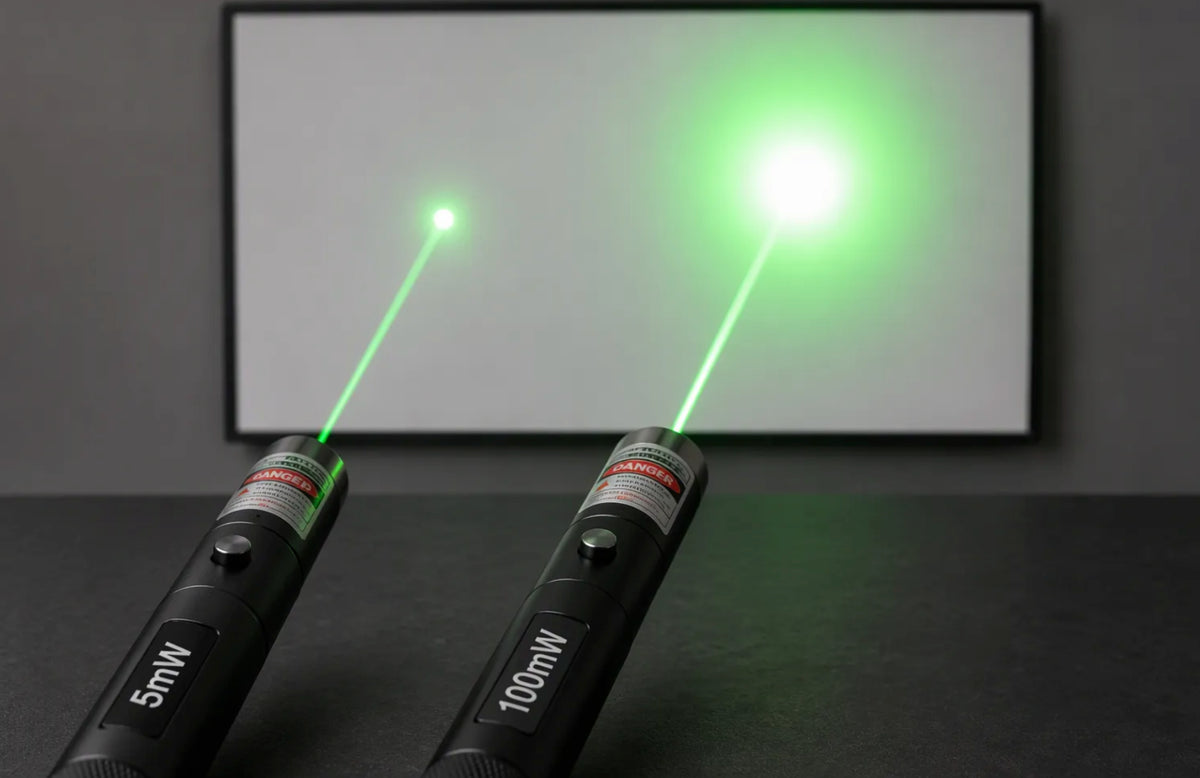
Does more power make a laser pointer brighter? Generally, yes—when the wavelength, beam characteristics, target, and viewing conditions are the same, increasing actual optical output usually makes the laser spot brighter or easier to detect.
However, the relationship between optical power and perceived brightness is not a simple one-to-one rule. Human eyes respond differently to different wavelengths. Beam divergence, spot size, target reflectivity, ambient light, and atmospheric conditions also affect what an observer sees.
That is why a higher-mW laser does not always look brighter than a different lower-mW model. This guide explains when more power increases brightness, why color changes the comparison, and why visible brightness should never be used as a measure of laser safety.
Key Takeaways
-
At the same wavelength and under comparable conditions, higher measured optical output generally produces a brighter or more detectable laser spot.
-
Perceived brightness does not necessarily increase in direct proportion to milliwatts.
-
Wavelength matters when comparing different colors. Green often appears brighter than blue or deep red at equal optical output.
-
Beam divergence, spot size, target reflectivity, ambient light, and viewing angle affect how bright a laser looks.
-
A visible spot and an airborne laser beam are different visibility questions.
-
Apparent brightness does not reliably indicate actual output or eye hazard. Check the optical-power specification and laser class separately.
Laser Pointer Power vs Brightness Basics

What mW Means for a Laser Pointer
Optical output is measured in milliwatts (mW) or watts (W). One watt equals 1,000 milliwatts, so a laser rated at 5mW has a stated optical output of 0.005W.
Watts measure power, not energy. Optical power describes how much radiant energy the laser emits per unit of time. When wavelength, beam size, and other viewing conditions are the same, higher optical output generally means more light reaches the target and a brighter-looking spot.
However, the mW rating alone cannot predict perceived brightness when the lasers being compared have different wavelengths, beam characteristics, or viewing conditions.
How Ambient Light and the Target Affect Brightness
The same laser can look very different under different viewing conditions. A spot on a surface is easier or harder to see depending on its contrast with the background, the target's reflectance, the spot size, and the surrounding light.
A visible beam in air is different. Observers see light scattered toward them by air molecules or particles, and its appearance depends on atmospheric conditions and viewing angle. Bright surroundings can reduce contrast even when the laser's actual optical output remains unchanged.
Does Increasing Optical Power Increase Brightness?
When two lasers have the same wavelength, similar beam characteristics, and comparable viewing conditions, the laser with higher measured optical output generally delivers more light to the same target area. That can increase the target's irradiance and its photometric output.
However, human perception is not perfectly linear. Doubling optical power does not mean that an observer will necessarily describe the spot as looking twice as bright. Higher output also does not automatically improve beam divergence or create a fixed increase in visible distance.
The important distinction is between a measurable increase in light and the way a person perceives that increase.
Why Wavelength Changes the Power-to-Brightness Comparison
Wavelength matters because the human eye does not respond equally to every visible color. Under light-adapted, or photopic, conditions, standard visual sensitivity peaks near 555nm.
Under dark-adapted, or scotopic, conditions, the sensitivity peak shifts toward shorter wavelengths, near 507nm. This means that two lasers emitting the same measured optical power can produce different photometric results.
It does not mean wavelength always matters more than power. Both must be considered, along with beam characteristics and viewing conditions.
Is More Power Always Better?
Brightness Is Not a Laser Safety Measurement
A brighter-looking laser is not necessarily more powerful, and a dimmer-looking laser is not necessarily safer. The FDA warns that powerful blue or violet beams may appear less bright than equally powerful red or green beams.
In the United States, visible laser products promoted for pointing or demonstration purposes are limited to FDA Class IIIa / IEC Class 3R, up to 5mW. This regulatory limit is not a universal boundary between safe and unsafe exposure.
Laser hazard depends on the actual output, wavelength, beam characteristics, emission conditions, and laser class. Never use visual brightness or the blink response to determine whether a laser is safe.
Why Laser Class Matters More Than Apparent Brightness
Laser class describes hazard potential, not how bright a product looks. Under simplified visible continuous-wave conditions, Class 3R can include products up to about 5mW, while Class 3B and Class 4 represent substantially higher hazard categories.
Class 3R can still present direct-viewing hazards. Class 3B and Class 4 products can present serious eye hazards, while Class 4 may also present skin, reflected-beam, and fire hazards. Exact classification depends on the applicable standard and emission characteristics.
The key takeaway is that the brightest-looking beam is not necessarily the most hazardous one.
Choosing the Right Power for Your Laser

What Else Affects Laser Pointer Brightness?
Optical output is an important factor, but it is not the only one that determines apparent brightness. When comparing two lasers, check whether the wavelength, beam divergence, spot size, target surface, and viewing conditions are comparable.
A fair brightness comparison should avoid changing several factors at once. If one laser has higher optical output but also produces a much larger spot, the apparent result may differ from a comparison using identical beam geometry.
The following factors explain why two products with different wattage ratings do not always look the way buyers expect.
Myths and Reliable Laser Light
Laser Pointer Power vs. Brightness: Common Misconceptions
Several common misconceptions come from treating optical power and perceived brightness as the same thing. Some people assume that doubling milliwatts always makes a laser look twice as bright. Others assume that color alone determines brightness, regardless of optical output.
Neither assumption is correct. The table below separates measurable optical power from the factors that affect human perception.
|
What Changes? |
Can It Change Measured Light at the Target? |
Can It Affect Perceived Brightness? |
|
Higher optical output |
Yes, under comparable conditions |
Yes, but not necessarily in direct proportion |
|
Different wavelength |
Changes spectral composition, not necessarily total optical power |
Yes, human visual sensitivity varies |
|
Beam divergence |
Changes how light is distributed over distance |
Yes, through spot size and concentration |
|
Focus or spot size |
Changes irradiance distribution |
Yes |
|
Target surface |
Changes reflected light |
Yes |
|
Ambient light |
Does not change source output |
Yes, through contrast and adaptation |
|
Atmospheric scattering |
Changes transmitted and scattered light |
Yes, especially for side-view beam visibility |
|
Laser class |
Not itself a brightness measurement |
No direct brightness ranking |
The table shows why a fair comparison needs more than a wattage number. When wavelength, beam characteristics, and viewing conditions remain the same, increasing optical power generally increases the light available at the target.
When those conditions change, two products with different mW ratings may appear brighter or dimmer for reasons unrelated to their output ranking.
Higher optical output can increase apparent brightness under comparable conditions, but it does not automatically improve beam divergence, battery life, or overall product quality. Color also matters, but wavelength alone cannot tell you which product has greater optical output. A higher-output laser may produce a more detectable distant spot under some conditions, yet it does not have a universal distance rating derived from watts alone.
Why Accurate Optical-Power Specifications Matter
Advertised output should be distinguished from documented optical-power measurements. A useful product specification identifies the wavelength, stated optical output, laser class, and measurement conditions.
If output test data are available, check whether the reading represents continuous, peak, or another defined operating condition and whether it was measured after the final optics. A regulated driver can help control electrical operation, but driver type alone does not verify optical output.
Similarly, housing material does not establish power accuracy or guarantee that the laser will maintain the same brightness during extended operation. When comparing Hgyuskl products with other brands, apply the same documentation standards to every model. For outdoor selection, apply the outdoor laser pointer buying checklist to the exact model.
Conclusion: Does More Power Make a Laser Pointer Brighter?
Yes, under comparable conditions, increasing actual optical output generally makes a laser spot brighter or easier to detect. However, perceived brightness does not rise in a simple one-to-one relationship with milliwatts.
When comparing different lasers, wavelength, beam divergence, spot size, target reflectivity, background light, and atmospheric conditions can change the result. That is why a higher-mW laser does not always look brighter than a different lower-mW model.
The key distinction is simple: optical power measures emitted radiation, while perceived brightness describes how that radiation appears to an observer. Never use brightness alone to estimate laser power, eye hazard, or product quality.
FAQ
Does a Higher mW Rating Always Mean a Brighter Laser Dot?
Not always when comparing different laser products. At the same wavelength and with comparable beam size, target, and viewing conditions, higher measured optical output generally produces a brighter or more detectable spot. However, different wavelengths, divergence, background contrast, and viewing conditions can change the result. Perceived brightness also does not necessarily increase in direct proportion to milliwatts.
Which Laser Color Looks Brightest at the Same Optical Power?
Under typical light-adapted viewing conditions, common green wavelengths such as 520nm and 532nm generally appear brighter than 445nm or 450nm blue and 650nm red at equal measured output. The order between blue and red depends on the exact wavelengths and visual adaptation. For example, under standard photopic conditions, 650nm red has higher luminous efficiency than 450nm blue. Color-based comparisons should therefore specify the wavelengths and viewing conditions instead of assigning one universal brightness ranking.
Does Doubling Laser Power Make It Look Twice as Bright?
Not necessarily. When wavelength, beam characteristics, and viewing conditions are the same, doubling optical output increases the measurable light delivered to a comparable target. However, human perception of brightness is not perfectly linear. The spot may look brighter without appearing subjectively twice as bright. The difference also depends on background contrast, viewing adaptation, and the target surface.
Share:
Does More Power Make a Laser Pointer Go Farther: Understanding Laser Pointer Power vs Distance