
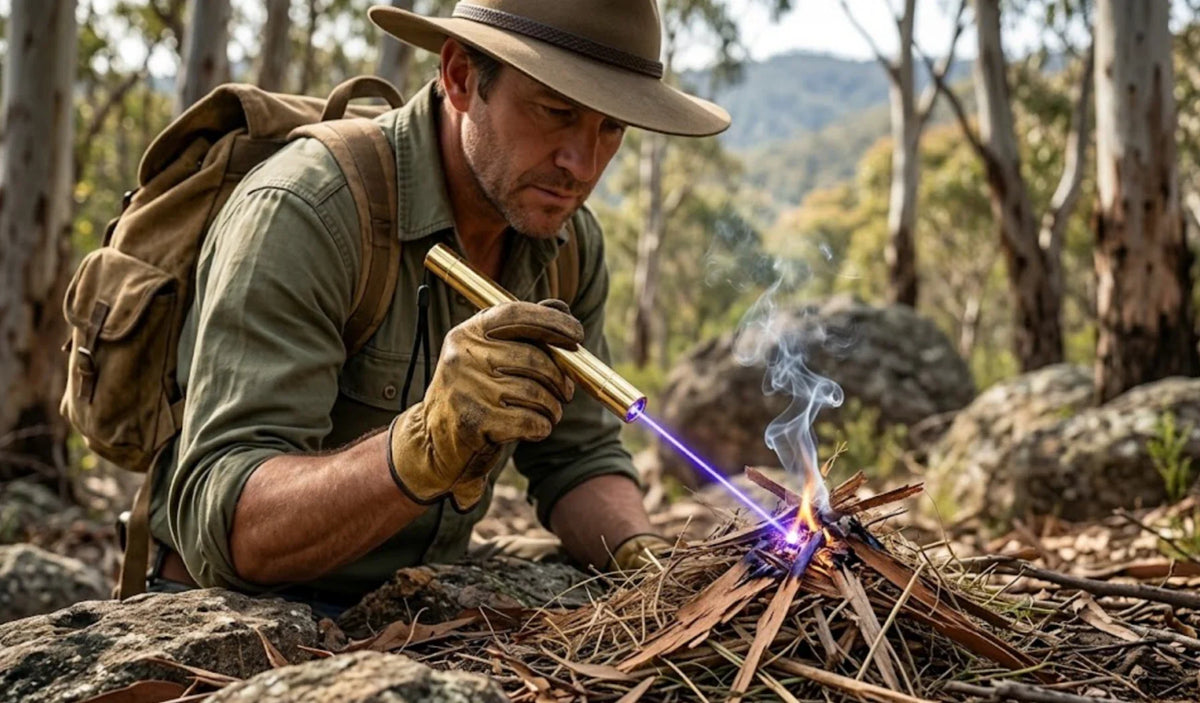
A optical output 450nm blue laser should not be treated as an essential survival tool or a substitute for emergency signaling equipment. Its wavelength identifies blue light; it does not guarantee daytime visibility, reliable ignition or suitability for wildlife control. This guide explains the limits behind those claims and the specifications to check when comparing blue laser products.
Survival Claims: What the Specifications Actually Establish
|
Claim |
What Needs Checking |
Practical Limitation |
|
Long-range visibility |
Ambient light, target and beam divergence |
A visible target spot does not guarantee a visible beam path or rescue signal |
|
Fire-starting ability |
Actual optical output and material response |
Possible ignition is a fire hazard, not a guarantee of reliable survival equipment |
|
Wildlife deterrence |
Species, site rules and purpose-built equipment |
A general handheld pointer is not proven harmless or suitable for animal control |
Rechargeability is only one part of preparedness. Equipment also depends on usable charge, operating conditions, maintenance and suitability for the task. Choose signaling, lighting and repair tools for their documented purpose rather than expecting one high-output beam to replace them.
Key Takeaways
-
A 450nm blue laser produces blue light, but its color and advertised power do not establish how far a spot or beam path will be visible.
-
High optical output can create heat and ignition hazards. That does not make a handheld laser a dependable replacement for appropriate fire-making equipment where fires are permitted.
-
Animal-deterrent claims need separate evidence and local guidance. A general laser pointer should not be aimed at animals or described as harmless wildlife protection.
-
Compare the exact output, laser class, duty cycle, battery requirements and operating instructions. Eyewear and a metal housing do not remove the need for a controlled, appropriate use environment.
Specifications to Check on a 450nm Blue Laser

Power and Range
Read optical output and range claims separately. Output should be stated in mW or W with a measurement basis; range should identify the target, lighting and whether it refers to a spot or a visible beam path. For Hgyuskl and other brands, request exact-model documentation rather than treating "true power," a housing material or a driver label as proof of tested performance.
|
Feature |
Information to Verify |
|
Power Output |
Stated optical output, measurement method and operating conditions |
|
Wavelength |
450nm describes blue light; check the exact model's label |
|
Material |
Model-specific housing material and documented operating limits |
|
Class |
Read the product label; wavelength alone does not determine laser class |
Neither optical output nor color establishes that a product is suitable for rescue, cutting or field repair. First identify the task and the equipment designed for it, then assess whether a laser has an appropriate role at all.
Daylight Visibility
Daylight can make both a laser spot and the beam path difficult to see. A high output does not guarantee visibility against bright backgrounds, through vegetation or in bad weather. Fog, rain and dust can scatter and attenuate light, so increased nearby beam visibility can occur alongside reduced visibility at a distance.
|
Feature |
Optical output 450nm Blue Lasers |
Equipment Designed for Signaling |
|
Visibility |
Depends on lighting, target, output and beam characteristics |
Compare documented visibility and intended conditions for the specific device |
|
Purpose |
A pointer label does not establish suitability for rescue signaling |
Choose a device with an appropriate signaling function and instructions |
|
Safety Protocols |
Requires control of direct and reflected exposure |
Follow the device's own handling and operating requirements |
|
Operating duration |
Battery runtime and permitted continuous on-time are separate limits |
Check documented battery life, consumables and operating duration |
Durability
Durability must be evaluated for the exact model. Housing material, seals, thermal design and battery construction all matter, but none proves an all-weather rating by itself. Look for stated temperature limits, a documented water-resistance rating if claimed, and clear instructions for storage and operation.
-
Check the model's stated operating-temperature range and the conditions used to establish it.
-
Output can change with temperature and operating time. A single percentage drop cannot describe every model without defined test conditions.
-
Check maximum on-time, cooling intervals and any thermal protection separately from battery runtime.
Compare documented limits with the conditions of the intended activity. A sturdy-looking case, a rechargeable battery or the word "tactical" is not evidence of emergency reliability.
Examining Common Survival Claims

Survival marketing often combines signaling, ignition, animal deterrence and cutting in one list. These are different tasks with different requirements. The following sections explain why a claim about one physical effect does not establish suitability for every task.
Emergency Signaling
Plan emergency communication around equipment intended for that purpose, such as an appropriate beacon, radio, emergency light, whistle or signal mirror. The choice depends on the environment and applicable guidance. A handheld blue laser is not a substitute simply because its beam looks bright in a photograph.
-
Check whether the signaling equipment is intended for the terrain, weather and type of emergency you are preparing for.
-
Review battery life, service requirements and the instructions for the exact signaling device.
-
A laser spot's contrast changes with target color, surface and background light. Reflective surfaces also introduce exposure hazards.
Keep backup communication and lighting appropriate to the activity. For general laser-selection criteria, see our outdoor laser buying checklist; it is a comparison guide, not a rescue-equipment recommendation.
Do not sweep a handheld laser above the horizon or toward aircraft, roads, vehicles, people or animals to attract attention. An apparently empty sky does not establish a controlled beam path.
Fire-Starting Claims and Ignition Risk
A sufficiently intense laser can heat or ignite some materials. Whether this occurs depends on the device, focus, material and conditions; it is not guaranteed by a 450nm label. In an outdoor setting, unintended ignition and uncontrolled reflections make this a hazard rather than a general survival recommendation.
-
Choose conventional fire-making equipment suited to the activity, where fires are permitted.
-
Check current fire restrictions and the conditions at the site before planning any use of flame or ignition equipment.
-
Keep laser beams away from combustible materials, fuel containers and unprotected surroundings.
A demonstration of burning material does not establish repeatability, reliability in poor weather or suitability for a survival kit. It also does not validate the product's stated optical output.
Wildlife-Deterrent Claims
Do not assume that a handheld blue laser is appropriate for protecting a campsite or moving wildlife. A visible response from an animal does not establish that exposure is harmless, humane or permitted.
-
Species and behavior matter; findings for one bird species do not establish effectiveness against predators or other animals.
-
A quoted study result needs an identifiable source, device specification, method and setting before it can support a product claim.
-
Professional deterrent systems may differ from handheld pointers in design, controls and operating procedures.
-
Protected-species rules, land-management policies and local restrictions must be checked for the actual location.
-
Use appropriate wildlife-management guidance for the situation instead of inferring a method from laser brightness.
This guide does not establish that any Hgyuskl model is suitable for animal deterrence. Keep general laser pointers away from animals.
Utility and Cutting Claims
A handheld laser is not a general replacement for appropriate cutting or repair tools. Material response varies, and heating can produce smoke, fire, reflections or damage outside the intended area. A controlled industrial laser process should not be equated with a handheld field repair.
-
Material response: Absorption depends on the material and wavelength. A dark appearance alone does not establish a predictable or appropriate heating process.
-
Work environment: A useful repair method needs suitable equipment, control of the work area and attention to material hazards, not only a concentrated light source.
-
Tool selection: Choose tools designed for the material and task. A product's ability to heat something does not prove that it can produce a safe, sound or accurate repair.
Protective eyewear alone does not control fire, fumes or every direct and reflected exposure. It is not a reason to attempt an unsuitable laser task.
Build a preparedness kit around the separate jobs it must perform: communication, lighting and appropriate basic repairs. Evaluate each item by its documented purpose and operating limits.
Comparing Outdoor Equipment by Purpose
Lasers vs. Flashlights
Flashlights and headlamps illuminate an area for navigation and work. Some also have signaling modes defined by their manufacturer. A laser concentrates light into a narrow beam and does not replace broad-area illumination; a bright spot or beam photograph is not a meaningful comparison of the two tools' usefulness.
For lighting, compare usable illumination, battery life, controls and documented weather resistance. For signaling, check the device's intended signaling function separately.
Handheld Lasers vs. Purpose-Built Signals
A general handheld blue laser and a purpose-built emergency signaling product are different equipment categories. Do not use the term "rescue laser flare" as if it certifies a higher-output pointer for rescue. Check the instructions, approvals where applicable, operating duration and limitations of the exact signaling product.
|
Feature |
General Handheld Blue Laser |
Purpose-Built Emergency Signal |
|
Visibility |
No universal day, night or all-weather visibility guarantee |
Use the manufacturer's stated conditions and limits |
|
Safety |
Direct/reflected exposure and possible ignition hazards |
Hazards depend on the signaling technology and handling |
|
Duration and reuse |
Depends on power supply, duty cycle and maintenance |
Depends on the device; some are reusable, others consumable |
|
Portability |
Dimensions and weight vary by model |
Dimensions and weight vary by device type |
When preparing for emergencies, follow guidance appropriate to the activity and location. Keep required signaling equipment maintained and check its condition before travel.
Comparing Blue Lasers With Other Colors
Changing wavelength changes color and visual response, but it does not establish survival suitability. At comparable optical output and viewing conditions, green commonly appears brighter than blue to human vision. Compare wavelength, optical output, beam divergence and operating limits independently; higher perceived brightness does not guarantee a longer usable range.
A comparison between colors should use stated wavelengths and similar conditions. Avoid treating a photograph or a single outdoor demonstration as a general performance test.
Safe and Responsible Use
Handling Tips
High-output lasers require attention to direct exposure, reflections, thermal effects and unintended activation. The appropriate controls depend on the product and task. A handheld format does not make a higher-class laser suitable for casual outdoor use.
Select protective eyewear through a hazard assessment for the actual wavelength, output and exposure conditions, using documented protection data. Follow the model's instructions and use appropriate lockout and storage. Never aim at people, animals, vehicles or aircraft.
A quick look around is not a substitute for a controlled beam path. Do not operate where people, traffic or aircraft could enter an uncontrolled exposure area.
|
Hazard Type |
Description & Prevention |
|
Direct Eye Exposure |
Higher-class lasers can cause serious eye injury. Eyewear must be selected for the actual wavelength and exposure assessment; a generic OD4+ claim does not establish suitability for every device. |
|
Diffuse Reflection |
Reflected light can also be hazardous, depending on the surface, laser and viewing conditions. Avoid direct or reflected exposure; a visible dot is not automatically safe to view. |
|
Aviation Hazards |
Never direct a laser toward aircraft, vehicles or roads. Do not rely on spotting aircraft first, or treat trees, hills or open ground as automatically controlled beam stops. |
|
Fire Risks |
High optical output can heat or ignite materials. Keep the beam away from combustible materials and fuels; do not treat this hazard as an emergency-use feature. |
Maintenance
Maintenance should follow the exact model's instructions. Before use, check the condition of the housing, controls, battery compartment and optics, and stop using a damaged or malfunctioning device.
-
Use the specified lens cap or protective cover during storage, where supplied.
-
Follow the manufacturer's cleaning method; do not add coatings or cleaning chemicals without guidance.
-
Respect stated on-time and cooling limits rather than modifying the heat sink or driver.
-
Follow storage guidance for temperature, moisture and the specified batteries.
-
Use only the stated battery and charging equipment; ask for missing requirements before choosing replacements.
-
Keep instructions and model identification available so that replacement parts, maintenance advice and operating limits can be checked against the correct device.
Maintenance can support operation within documented limits, but it does not create a weather rating or establish reliability for emergency signaling.
A 450nm blue laser is not an all-purpose survival essential. Choose emergency communication, lighting and repair equipment for their intended roles, and assess any laser by its exact specifications and an appropriate use environment. When comparing Hgyuskl models, request missing documentation and distinguish listed specifications from independently measured performance.
FAQ
Is a optical output 450nm blue laser essential for survival?
No. The wavelength and advertised output do not establish suitability for emergency signaling, wildlife control or field repairs. Choose equipment designed for the specific preparedness task; a general handheld laser is not a substitute for a suitable beacon, radio, emergency light or other required signal.
Can a 450nm blue laser start a fire?
A sufficiently intense laser can heat or ignite some materials, depending on the device and conditions. This is a fire hazard, not proof of reliable fire-starting performance or a reason to include a higher-output pointer in a survival kit. Keep laser beams away from combustible materials and fuels.
Is it safe to carry a optical output 450nm blue laser?
Carrying and operating requirements depend on the product and location. Follow the exact model's storage, lockout and battery instructions, prevent unauthorized activation, and check applicable transport rules. A case or protective eyewear does not make every use appropriate.
Can a laser replace a flashlight or emergency beacon?
No. A flashlight provides illumination, while an emergency beacon or other signaling product serves a defined communication or alerting role. A narrow laser beam does not replace those functions. Compare equipment by its intended purpose, operating duration and documented conditions.
What should you check before traveling with your laser?
Check current rules for the device and its batteries with the carrier, destination and relevant authorities. Review labeling, documentation and transport restrictions for the exact product. Proof of ownership alone does not establish that carrying or using it is permitted.
Share:
The Green Revolution: How Green Laser Pointers Enhance Office and Classroom Presentations
Why High Visibility Green is the Standard for Amateur Astronomy