
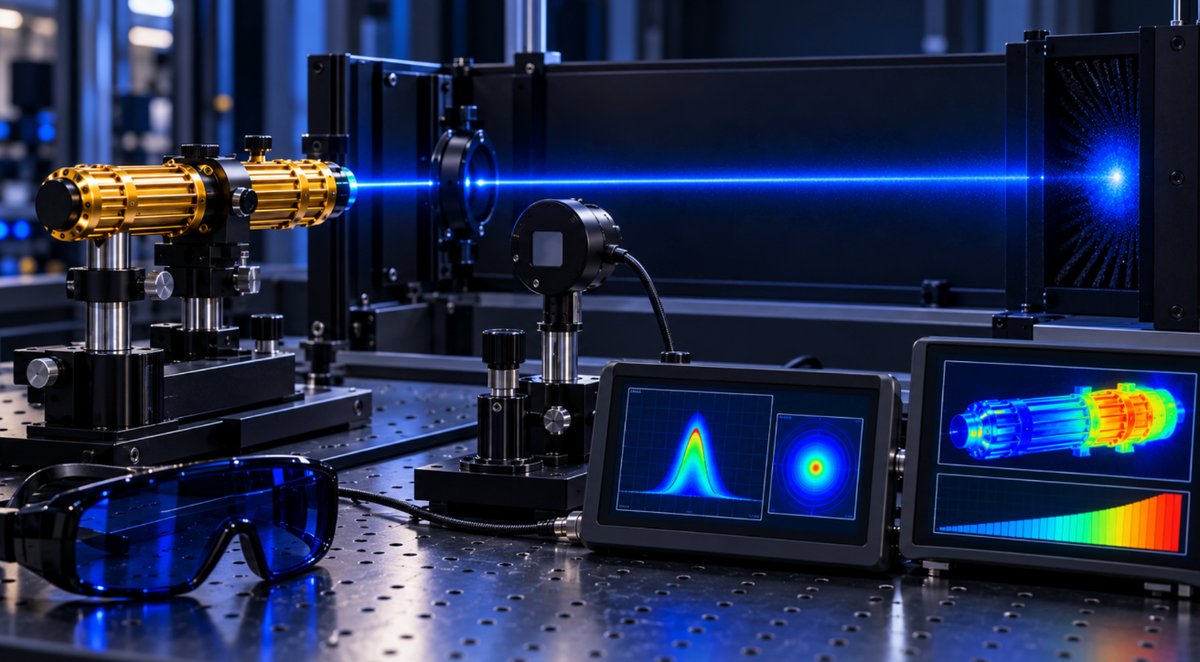
Looking for the most powerful blue laser pointer? The largest wattage number in a product title is not enough to identify the strongest or best-performing handheld laser.
Most high-output blue handheld lasers use wavelengths around 445nm or 450nm, and some models are advertised with multi-watt optical output. However, advertised wattage, documented output, beam quality, runtime, and safety information are different things.
Before comparing products, check the stated optical output, measurement conditions, laser class, wavelength, beam divergence, duty cycle, battery system, safety controls, and warranty.
This buying guide explains how to compare high-output blue laser models without confusing marketing claims with verified specifications.
Key Takeaways
-
Compare documented optical output rather than ranking blue laser products by advertised wattage alone.
-
Check whether the output rating represents continuous, peak, or another defined measurement condition.
-
Compare the exact wavelength, laser class, beam divergence, focus design, battery requirements, and duty cycle for each model.
-
Review the product's safety controls, warning labels, operating instructions, and applicable legal restrictions.
-
Do not assume that an aluminum body, a specific driver type, or a higher price proves better thermal performance or actual optical output.
-
For higher-class laser systems, protective eyewear and other controls must be selected according to the wavelength, output, and specific hazard assessment.
Why Blue Lasers Are the Strongest

Direct Diode Efficiency at 445 nm
Most high-output blue handheld lasers use direct laser diodes operating around 445nm or 450nm.
Direct-diode technology differs from traditional 532nm green DPSS systems, which commonly use infrared pump light and frequency conversion. However, 520nm green lasers can also use direct diodes, so it is incorrect to describe all green lasers as DPSS systems.
The advantage of a particular blue diode depends on its design, rated optical output, electrical requirements, efficiency, beam profile, and thermal limits. For buyers comparing 445nm and 450nm products, the exact model specifications matter more than a broad claim that one color or diode architecture is universally stronger.
Comparing Hgyuskl Blue Laser Models
Hgyuskl currently lists several 450nm handheld laser models with different advertised output ratings.
The table below compares selected product listings rather than independently verified optical-power measurements. An advertised 15,000mW model should not automatically be considered stronger in actual measured performance than a lower-rated model without comparable measurement data.
Before choosing a specific version, confirm the current product specifications, safety class, battery requirements, duty cycle, and documentation on its product page.
|
Model |
Advertised Blue Output |
Wavelength |
What Buyers Should Verify |
|
HG-A690 |
15,000mW |
450nm |
Measurement evidence, duty cycle, battery system, thermal design, laser class |
|
HG-B017 — selected version |
Up to 5,000mW |
450nm |
Measurement evidence, duty cycle, battery system, thermal design, laser class |
|
HG-B009 |
3,000mW |
450nm |
Output documentation, duty cycle, battery compatibility, beam specifications |
|
HG-990 |
1,500 / 3,000mW |
450nm |
Selected wattage, driver documentation, thermal limits, safety labels |
|
HG-B008 — blue variant |
1,500mW |
450nm |
Confirm blue variant, focus, battery requirements, output documentation |
The most useful comparison is not simply which model has the highest advertised wattage. Two blue laser products with different output ratings may also differ in duty cycle, battery requirements, thermal limits, beam divergence, focus design, and safety controls.
If comparable measurement data are unavailable, describe the products by their advertised specifications rather than ranking them as independently verified power leaders.
Blue vs. Green vs. Red: Power and Brightness
Blue Laser Power vs. Perceived Brightness
Measured optical output and perceived brightness are not the same thing. At equal optical output, 520nm and 532nm green light generally appears brighter to human eyes than 445nm or 450nm blue light under typical viewing conditions.
This does not mean the green laser has more optical power. A high-output blue laser can look less bright while still belonging to a much higher hazard class than a lower-output green laser. When comparing blue laser products, use measured or clearly documented mW/W specifications rather than visual brightness to evaluate output.
|
Comparison |
What It Means |
|
Optical output |
Measured power in mW/W |
|
Wavelength |
Color and part of perceived visibility |
|
Apparent brightness |
Human visual response under specific viewing conditions |
|
Laser class |
Hazard potential |
|
Beam divergence |
Beam spread with distance |
Safety Risks of High-Power Blue Lasers

Eye Hazards and Protective Eyewear
A high-output blue laser can present a serious eye hazard even when the visible beam does not look especially bright.
Risk depends on wavelength, optical output, beam characteristics, exposure conditions, and laser class.
Class 3B and Class 4 systems can present serious direct-eye hazards, and Class 4 systems may also create hazardous reflected exposure, skin hazards, and fire risks.
Protective eyewear, when required, must be selected for the actual wavelength and specific hazard assessment. The optical density or protection rating must be appropriate for the exposure conditions.
Ordinary sunglasses are not laser protective eyewear, and protective glasses alone do not make an uncontrolled beam safe.
Duty Cycle and Thermal Limits
There is no universal safe on-time or cooling interval for every high-output blue laser. The appropriate duty cycle depends on the exact diode, driver, housing, heat-transfer design, optical output, battery system, ambient temperature, and manufacturer specifications.
Before buying, check whether the product clearly states its maximum recommended on-time, required cooling interval, operating-temperature range, and any thermal-protection features.
Do not use a generic 60-second-on / 120-second-off pattern as a substitute for model-specific operating instructions.
Most Powerful Blue Laser Pointer: Key Specifications to Compare
Optical Output, Measurement Basis, and Beam Quality
Start with the stated optical output in milliwatts or watts. Check whether the figure represents continuous-wave emission, pulsed or peak output, output before or after the final optics, and the operating conditions under which it was measured.
“Continuous wave” describes the emission mode. It does not automatically prove that the product can operate indefinitely or maintain the same output at every temperature. For high-output blue lasers, beam divergence and beam profile are also important because two products with similar wattage can produce different beam shapes and spot sizes.
Compare the exact model specifications rather than relying on one wattage number. Beam divergence describes how quickly the beam expands with distance. A lower divergence can help maintain a smaller spot under comparable conditions, but it does not increase total optical output. Adjustable focus changes the beam's optical configuration and spot size. It should not be treated as evidence of higher wattage.
Driver design also matters, but neither a linear nor a switching topology is automatically superior. Stability depends on the complete circuit design, thermal conditions, power source, and operating range. Buyers should compare clearly documented beam specifications and operating limits rather than judging quality from driver terminology alone.
Thermal Design and Output Stability
High-output blue laser products can generate substantial internal heat, but their thermal behavior varies by model. Actual performance depends on diode efficiency, electrical losses, heat-transfer design, housing dimensions, ambient temperature, operating duration, and thermal-protection features.
Do not assume that every 3W model requires a fan or that every passive-cooled product loses a fixed percentage of output after a certain number of seconds. When comparing models, look for documented operating limits, duty-cycle information, thermal design details, and measurement data where available.
A higher purchase price or a specific driver topology does not independently prove superior thermal performance.
Housing, Battery, and Operating Limits
Housing materials affect durability and heat transfer, but the complete thermal design matters more than one material name.
Aluminum, copper, brass, and other materials can be used in different ways depending on the design. A copper component does not automatically prove that the product has better cooling or longer runtime.
Battery requirements are also specific to each model. Check the specified cell type, nominal voltage, polarity, discharge requirements, and charging instructions.
Do not substitute 18650, 26650, or other cells merely because they are rechargeable lithium-ion batteries.
Before buying, confirm that the product provides appropriate battery specifications and model-specific duty-cycle guidance.
The highest raw milliwatt power comes from blue lasers. At the same output, green lasers look brighter to your eye. This tradeoff affects every buying choice. Always put safety and the law before raw power. The strongest blue laser pointer is useless if it harms your eyes or breaks local rules. Before you buy, run this mental checklist:
-
Compare wavelength and real output.
-
Confirm certified safety features.
-
Check legal compliance in your area.
-
Review duty cycle and thermal limits.
Upgrade your gear with Hgyuskl's True High Power tools, built for real-output performance you can trust.
FAQ
Can a blue laser pointer burn or cut materials?
A 445 nm blue diode delivers more energy per photon than green or red. That energy gives you a real edge in burning and cutting. True High Power units rated at 1,000 mW or more handle these jobs best. Always wear rated goggles and follow duty cycle limits.
Why does a green laser look brighter than a blue one at the same power?
Your eye peaks at 555 nm, close to the green 532 nm wavelength. That green beam reaches 88% of your maximum sensitivity. A 445 nm blue beam reaches only 3%. So green appears about 29 times brighter at equal output power.
How long can I keep a high-power blue laser turned on?
Run it 60 seconds, then let it cool 120 seconds. This duty cycle protects the diode. A true 3000 mW unit loses at least 15% power within 90 seconds without active cooling. Check the manufacturer's rating before you start.
Are high-power blue lasers legal to buy?
Laws differ by location. The U.S. FDA limits pointer sales to under 5 mW. New South Wales and Victoria ban battery-operated pointers above 1 mW. Any unit above 500 mW counts as Class 4. Confirm your local rules before ordering.
Which safety glasses protect my eyes from a blue laser beam?
Buy laser goggles rated for 445–450 nm. Choose a pair with high optical density, such as OD4+. Regular sunglasses offer almost no protection. Even a reflected beam can cause permanent damage. Wear the goggles every single time.
Share:
Strong Laser Pointer vs High Power Laser Pointer: Is There a Difference?
Most Powerful Green Laser Pointer: What Should You Compare Before Buying?