
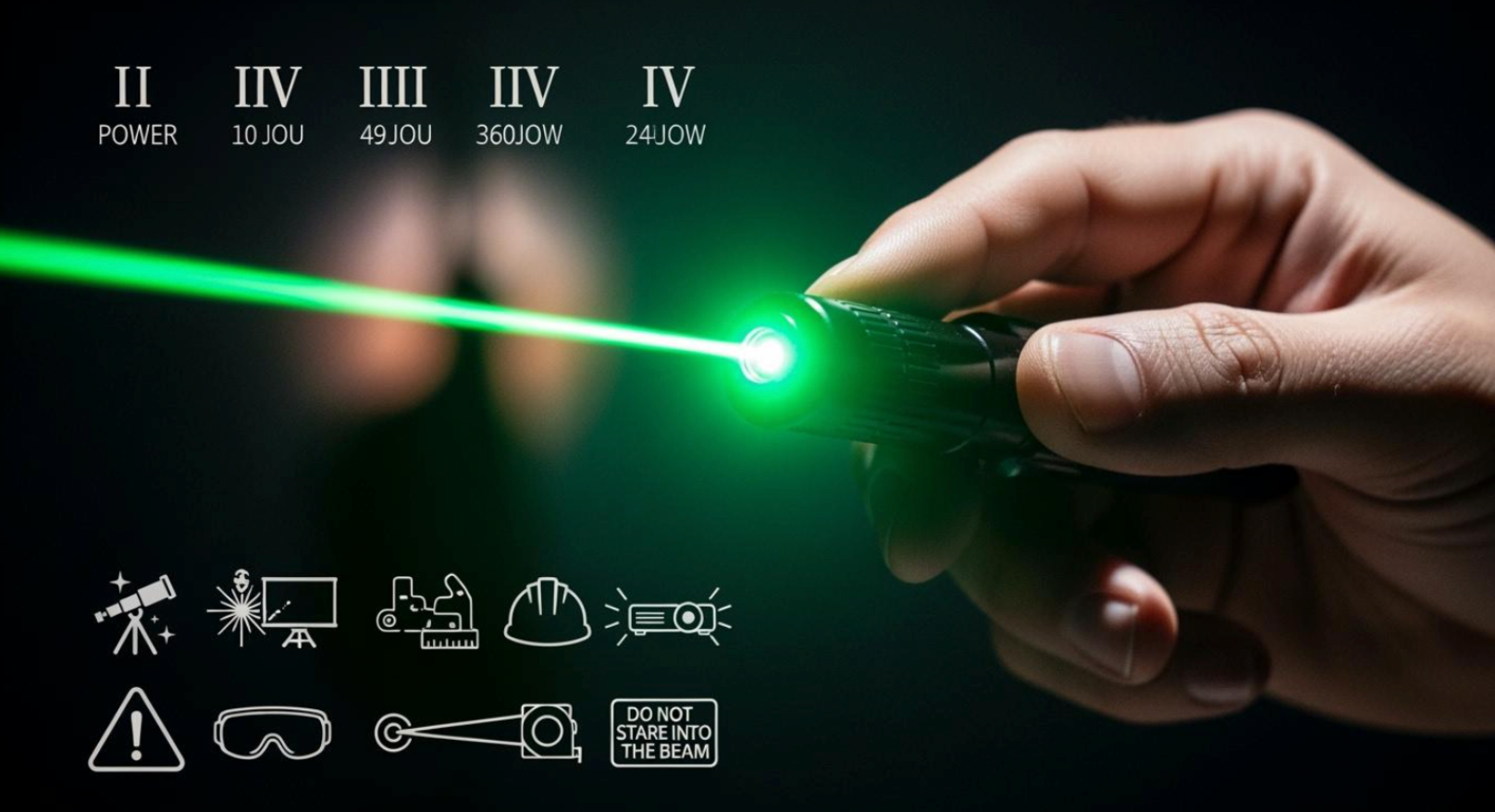
High power laser pointers require much more caution than ordinary low-power pointers. A stronger beam can create serious eye-safety risks, skin hazards, fire risks, and legal restrictions if it is used incorrectly.
Before buying any high-power laser product, you should understand three things first: the laser class, the labeled output power, and whether the product is legal and appropriate for your intended use. In many markets, products above 5mW may fall into higher hazard classes and should not be treated as general-purpose laser pointers.
Key Takeaways
-
You should always think about safety first when using high power laser pointers. Make sure to follow your local laws and safety rules so you do not have accidents.
-
Learn the difference between laser classes before buying. Class 1 and Class 2 products are lower-risk when used as intended, while Class 3R, Class 3B, and Class 4 products require progressively stricter safety controls.
-
Read the labels closely before you buy a laser pointer. Check for safety marks and real power numbers so you do not get a dangerous fake.
-
Pick the lowest power you need for your job. This helps lower risks and keeps you and others safe from getting hurt.
-
Do not ever point a laser at people or shiny things. This can hurt eyes badly or make bright reflections that could hurt you.
High Power Laser Pointer Safety
Main Risks
Using a high power laser pointer can be dangerous. You can get hurt if you do not follow laser safety rules. The biggest risk is shining the beam into your eye. Even a short look can cause damage that does not heal. You could get retinal burns or macular holes. Some people even lose their sight. The World Health Organization says lasers above class 2 are not safe for most people because they can hurt your eyes.
Here are the main dangers you need to know:
-
Retinal burns can happen fast and may never heal.
-
Macular holes and retinal hemorrhage can happen if you use lasers wrong.
-
Your retina can get damaged, and you might have vision problems for a long time.
-
Adults and kids have hurt themselves with handheld laser pointers.
-
Even weak beams can hurt your eyes if you stare at them for too long.
Your skin can also get hurt. High power beams can burn or bother your skin. If you use bad devices or try to change them, you could get shocked. Lasers can start fires if you point them at things that burn easily. These dangers show why you must be careful with laser pointers.
Tip: Never shine a laser pointer at someone’s eyes or skin. Do not point the beam at shiny things. Reflections can hurt you by surprise.
If you want to know more about being safe, check our Laser Safety Resource Center for more tips and news.
Why Power Class Matters
Power class tells you how strong a laser pointer is. Each class has its own risks. Class 1 and 2 lasers are safe for most people. Classes 3B and 4 are much stronger and can hurt you badly. You need to know how much exposure is safe for each class.
When you pick a high power laser pointer, look at the label for the right power class. Real brands like Hgyuskl use good materials and true numbers. We do not make up power ratings. Our products meet all big safety rules, like ANSI Z136.1 and FDA regulations.
Laser pointer safety means knowing the risks and picking the right device. Always wear eye protection with high power lasers. Never use a laser pointer in ways that could hurt you or others. If you want to learn more about power classes and safety, check our Laser Pointer Power Classes Guide.
Note: The right power class keeps you safe and helps you follow the law. Always pick a device that fits your needs and local rules.
If you know the dangers and follow laser safety rules, you keep yourself and others safe.
Laser Pointer Power Classes

Knowing about laser pointer power classes helps you pick the right device. It also keeps you safe. You need to learn the rules and limits before buying a high power laser pointer. Each class has its own features and safety risks. Green laser pointers and red laser pointers come in different classes. Always check the label and follow the rules.
Class 1 & 2: Everyday Use
Class 1 and Class 2 laser pointers are safe for most people. You can use them in schools, offices, and for learning. Class 1 lasers are safe in normal situations. Class 2 lasers use visible light and have power up to 1 mW. Your eyes blink to protect you from quick exposure. Green laser pointers and red laser pointers in these classes are used for teaching and work.
|
Laser Class |
Typical Output Direction |
Buying and Safety Meaning |
|
Class 1 |
Enclosed or inherently low-risk laser products |
Generally low risk when used as designed |
|
Class 2 |
Visible lasers up to 1mW |
Lower-risk for normal pointing use, but intentional staring should still be avoided |
|
Class 3R / IIIa |
Visible lasers up to 5mW |
Common upper range for many pointer-style products where allowed by law |
|
Class 3B / IIIb |
5mW–500mW |
Higher-risk laser class; not appropriate for casual pointing or public use |
|
Class 4 / IV |
Above 500mW |
Highest-risk class; can create serious eye, skin, and fire hazards and requires strict controls |
Class 3R: Moderate Power
Class 3R laser pointers have moderate power. People use them for advanced presentations and astronomy. Green laser pointers in this class are brighter and easier to see. Red laser pointers also make clear beams. You must be careful because even short exposure can cause flash-blindness or afterimage. Rules say you should not look at the beam and must follow safety steps.
Class 3R lasers are often used for controlled pointing tasks where local laws allow them, such as supervised presentations or responsible astronomy pointing. They should never be aimed at people, animals, vehicles, aircraft, reflective surfaces, or public spaces.
Class 3B & 4: High Power & Professional Use
Class 3B and Class 4 laser pointers are strong tools. They are used for science, research, and industry. Green laser pointers and red laser pointers in these classes can hurt your eyes and burn your skin. You must wear safety gear and follow strict rules. Hgyuskl makes these devices for professionals, using strong metal cases and APC constant current drives.
|
Application Type |
Examples |
|
Science and research |
Lab experiments |
|
Laser cutting machines |
Industrial work |
|
Show lasers |
Entertainment |
|
Cosmetic lasers |
Medical procedures |
Always pick a high power laser pointer that meets ANSI Z136.1 and FDA rules. Learn more about rules in our Laser Pointer Compliance Guide.
Legal Limits
Legal limits keep you and others safe. Most countries limit laser pointer power to 5 mW or less. Green laser pointers and red laser pointers above this limit need special permits. Rules are different in each place, so you must check local laws.
Laser laws vary by country, state, and local area. In the United States, laser products promoted for pointing or demonstration purposes are generally limited to Class IIIa / IEC Class 3R levels, which means 5mW or below in the visible wavelength range. Products above this level may fall into higher hazard classes and may not be legal for general pointer use.
Rules in the European Union, the United Kingdom, Australia, Canada, and other regions may differ by product type, import status, public use, and local enforcement. Always check local laws before buying, importing, carrying, or using a high-power laser product.
You must follow rules and legal limits to avoid trouble. For more info, visit our Laser Pointer Power Classes Resource.
If you follow rules and pick the right laser pointer, you keep yourself and others safe. Hgyuskl makes high power laser pointer devices for professionals, always meeting safety and rule requirements.
Use Cases & Recommendations
Astronomy & Stargazing
For beginner astronomy and public stargazing, a high-power laser is usually not the right choice. Green wavelengths can be highly visible at night, so a lower-power green laser pointer, typically 5mW or below where local laws allow, is often enough for responsible constellation pointing.
The goal in astronomy is controlled visibility, not maximum output power. Never point any laser toward aircraft, vehicles, people, animals, or reflective surfaces, and stop using it immediately if aircraft are nearby.
-
Pick green lasers so people can see the beam.
-
Use pointers with true power, not fake numbers.
-
Always follow your local laws and safety steps.
Hgyuskl makes astronomy tools with strong aluminum cases and steady power drives. For more help, check our Astronomy Laser Guide.
Outdoor & Survival
A high-power laser pointer should not be treated as an emergency signaling device. If you need emergency signaling equipment, use tools specifically designed and approved for that purpose, such as emergency beacons, signal mirrors, lights, or other regulated safety devices.
High-power lasers should never be aimed toward aircraft, vehicles, roads, people, animals, reflective surfaces, or public areas. Outdoor visibility is not a reason to choose excessive output power.
Hgyuskl laser pointers are made with strong parts for tough outdoor use. You can count on them even in bad weather.
Wildlife Control
Wildlife or bird-deterrent applications require separate safety, legal, and humane-use guidance. Do not assume a general high-power laser pointer is appropriate for animal deterrence. Users should check local wildlife rules, protected-species regulations, and product suitability before considering any laser-based deterrent method.
Lab & Industrial
Controlled Technical, Lab, and Industrial Use, Laboratory and industrial laser applications require controlled beam paths, suitable protective eyewear, trained operators, warning labels, access control, and documented safety procedures. A handheld high-power laser pointer should not be treated as a substitute for a regulated laboratory or industrial laser system.
If a higher-class laser is required for technical work, buyers should choose purpose-built equipment and follow workplace laser safety requirements.
|
Safety Protocol |
Description |
|
Labeling Requirement |
Lasers must show their class and power on the label. |
|
General Safety Advice |
Never look into the beam or point it at people. |
Hgyuskl makes lab lasers with real power and pro parts. You get good results and clear labels. For more tips, see our Lab Safety Guide.
Always use the right laser for each job. Pick the right power class and features to keep everyone safe. Safety is important every time.
Safety Risks & Real Incidents
Many people have been hurt by high power laser pointer accidents. These injuries have made people worry about safety all over the world. You should know the real dangers before using these devices. Even a quick flash from a laser can badly hurt your eyes. Some people lose their vision for a long time.
Eye & Skin Hazards
The biggest danger is when the laser beam hits your eye. This can hurt you right away and the damage might never go away. Many accidents have caused bad burns on the retina and even blindness. Some people have other eye problems too. Real-world injuries from handheld laser misuse have been reported in many contexts, especially when products are overpowered, mislabeled, or used by children without supervision. The FDA has warned that some laser products sold online may not meet federal safety requirements and may be unsafe for general consumers.
|
Exposure Area |
Possible Risk |
|
Eyes |
Temporary glare, afterimages, retinal injury, or permanent vision damage depending on class, power, distance, and exposure time |
|
Skin |
Irritation or burns may occur with higher-power lasers, especially at close range |
|
Materials |
Class 4 lasers and some high-power beams can create fire risks when used near flammable materials |
Your skin can get burned if the beam touches it. Sometimes these burns do not heal and can cause bigger problems later.
Never shine a laser at someone’s face or body. Always wear eye protection with high power laser pointers. For more info, visit our Laser Safety Resource Center.
Visibility & Distraction
Laser pointers can make a bright glare and distract people. Pilots and drivers are in danger if this happens. Laser beams can distract or temporarily impair pilots and drivers, especially when aimed toward aircraft, roads, or vehicles. The FAA treats laser strikes against aircraft as a serious safety threat, and people who shine lasers at aircraft can face significant civil and criminal penalties.
Green lasers are much brighter than red ones. They can be 35 times brighter, so they are more dangerous. The UK Health Protection Agency says strong green lasers are not safe for everyone.
-
Never point a laser at cars, planes, or things that move.
-
Always look around to make sure you do not hit anyone by mistake.
You can learn more about these dangers in our Laser Pointer Compliance Guide.
Electrical Hazards
High power laser pointers can also cause electric shocks and fires. Shiny things like mirrors, glass, or metal can bounce the beam back. This can hurt you when you do not expect it. Even dull surfaces can reflect enough light to hurt you if you are close. Class 4 lasers can start fires. Class 3B lasers can also cause fires if they are strong enough.
-
Keep things that can burn away from the laser beam.
-
Always have a fire extinguisher for electrical fires nearby.
Find more safety tips in our Lab Safety Guide.
Watch out for all dangers. Using high power laser pointers safely keeps you and others safe.
Safety Recommendations & Buying Guide
When you buy a high power laser pointer, you need to be safe. You should know how to read labels and spot fake devices. You must also follow the rules and use safe habits. These steps help you stay safe and follow the law.
Reading Labels
Always look at the label before you buy a laser pointer. The label tells you important things about the device and its risks. A good label helps you stay safe and follow the rules. Look for these things on the label:
|
Requirement |
Description |
|
Warning logotype |
A picture that shows the danger level. |
|
Specific warning statement |
Clear words about the risks and dangers. |
|
Maximum output |
The highest power the laser can make. |
|
Pulse duration |
How long the laser pulse lasts if it pulses. |
|
Laser medium or emitted wavelength |
The type of laser and the color of light it makes. |
|
Identification label |
The maker’s name and product details. |
|
Manufacturer's name and address |
The company’s name and where it is. |
|
Place of manufacture |
Where the laser was built. |
|
Month and year of manufacture |
When the laser was made. |
You should see the class, power, and color of light on the label. If the label is missing or handwritten, do not buy it. For more help, check our Laser Pointer Compliance Guide.
Spotting Fakes
Many laser pointers are fake or have wrong labels. These can be dangerous and hurt you. You need to know how to find fakes to stay safe. Here are signs that a laser pointer might be fake:
Red flags include exaggerated mW claims, missing laser class information, unclear wavelength, no manufacturer identification, no warning label, no user instructions, and marketing language such as “burns instantly,” “military grade,” or “no goggles needed.”
Product size or battery type alone does not prove whether a laser is safe, compliant, or accurately labeled.
A study found that most laser pointers were stronger than their labels said. This means you must be careful when you shop online. Some sellers do not follow the rules and sell unsafe products. You should buy from brands you trust that follow safety rules.
To check if a device is real, do these things:
-
For lasers over 5 mW, buy from trusted industrial sellers.
-
Make sure there is IR filtering. Good sellers show graphs or say 'IR filtered.'
-
Check for a safety key that stops the laser from turning on by accident.
-
Do not buy lasers that say they can burn or pop balloons.
-
Check the seller’s history. Pick sellers with good reviews and real buyers.
You can also look in the FDA’s Laser Product Database to check registration. Ask for a new power test report from another company. Check the label for class, power, and color of light. Use an IR card to see if there is IR light. For more tips, see our Buying Guide Resource.
Compliance Tips
You must follow the rules to own and use a high power laser pointer. Following the rules keeps you safe and out of trouble. Here are some important tips:
|
Compliance Tip |
Description |
|
Check for FDA/CDRH compliance |
Make sure the label has the maker’s name, model, and a safety statement. |
|
Verify wavelength and classification |
Class 3R lasers should say 'Class IIIa' or 'Class 3R' and be 5 mW or less. |
|
Demand test data |
Ask sellers for power test reports from other companies. |
|
Avoid red flags |
Watch out for words like 'military grade' or 'no goggles needed.' |
|
Source from industrial suppliers |
For lasers over 5 mW, buy from trusted industrial sellers. |
Always check your local rules before you buy. If you want to learn more, visit our Laser Pointer Power Classes Resource.
Best Practices
You must use safe habits to lower risk and stay safe. These tips help you use your high power laser pointer the right way.
-
Never point a laser pointer at people. Only use it to show objects.
-
Do not point at shiny things. Never look into the beam or use tools unless they are safe.
-
Use the lowest suitable output power and avoid direct or reflected exposure. Do not modify the beam, optics, or power system unless you are trained and working in a controlled environment.
-
Laser pointers are not toys. Keep them away from kids. Take out batteries when not using.
-
Register your device at your work. Put up warning signs.
-
Light between 400 and 500 nm can cause skin problems like sunburn.
-
Shiny surfaces can bounce the beam back at full strength.
-
Dull surfaces can still be risky.
-
Strong lasers can blind pilots from far away.
You must always wear eye protection with high power laser pointers. Keep things that can burn away from the beam. For more safety tips, visit our Laser Safety Resource Center.
Remember, following safety tips and rules keeps you safe from danger. Pick real devices, follow the rules, and use your laser pointer the right way.
You should learn about power classes and use cases before buying a high power laser pointer. This helps you stay safe and follow the rules.
-
Make sure your laser pointer follows the law.
-
Pick brands you trust for correct information and safety.
-
Visit sites like LaserPointerSafety.com to get more facts.
|
Issue |
Reputable Brands |
Non-Reputable Brands |
|
Safety Standards |
Follow regulations |
Often break rules |
|
Product Accuracy |
Real numbers |
Wrong or fake claims |
Keep learning and choose Hgyuskl for tools that work well and keep you safe.
FAQ
What makes a high power laser pointer different from a regular pointer?
A high power laser pointer uses more energy. Its beam is brighter and goes farther. You can see the beam during the day or from far away. Always check the power class before using one.
Is it legal to own a high power laser pointer in my country?
You need to check your local laws. Many countries only allow laser pointers up to 5 mW. If you use a stronger one without permission, you could get a fine or get in trouble.
How do I use a high power laser pointer safely?
-
Never point the beam at people, animals, or cars.
-
Always wear safety goggles with high power lasers.
-
Use the lowest power you need for your job.
Safety first: Always follow label warnings and local rules.
How should I compare Hgyuskl with other high-power laser brands?
Compare Hgyuskl or any other brand by checking the labeled output power, wavelength, laser class, warning labels, safety features, manufacturer information, build quality, and available documentation. Do not choose a high-power laser product based only on advertised brightness or distance claims.
Share:
Green Laser Pointer Buying Guide: Power, Visibility, Safety, and Buying Tips
Are Green Laser Pointers Legal in the US and Europe? Buyer Safety Checklist